
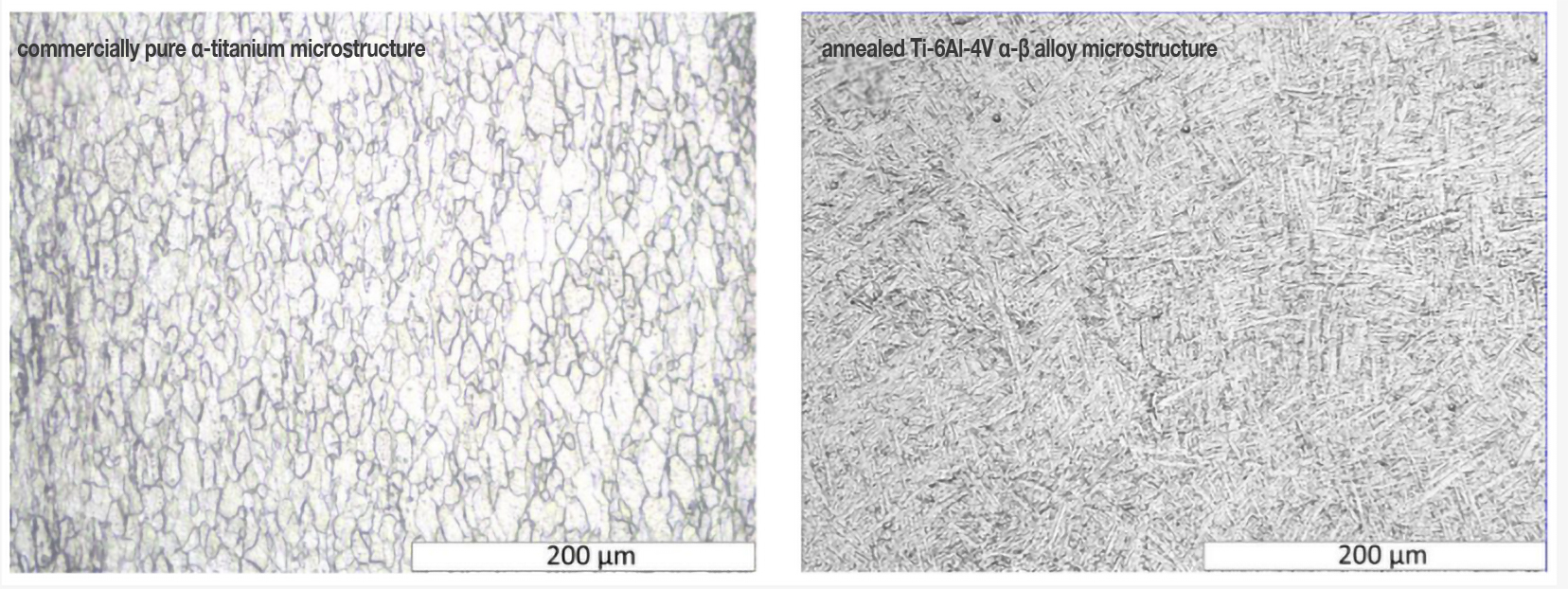
Understanding the microstructure of titanium alloys is essential for selecting the right material for medical and biomedical applications. As a global supplier and exporter of medical-grade titanium, we provide alloys engineered for optimal performance, biocompatibility, and long-term reliability.
Titanium Alloy Microstructure – Key Phases Explained
Most titanium used in medical devices and implants is alloyed with specific elements to enhance its mechanical and biological properties. Even commercially pure titanium (CP-Ti) contains trace elements that influence its final performance.
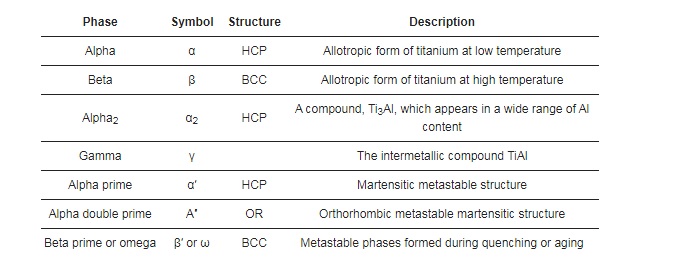
Titanium alloys are defined by two primary crystalline phases:
- Alpha (α) phase – hexagonal close-packed (HCP) structure
- Beta (β) phase – body-centered cubic (BCC) structure
The balance between these phases plays a critical role in determining:
- Strength and hardness
- Ductility and fatigue resistance
- Corrosion resistance
- Biocompatibility
A comprehensive list of titanium alloy phases, along with their symbols and space groups are listed in the table below:
Alloying Elements and Phase Stabilization
Titanium alloying elements are classified based on their influence on phase stability:
Alpha (α) Phase Stabilizers
Alloying element:
- Aluminum (Al)
- Tin (Sn)
- Zirconium (Zr)
- Increase strength and hardness
- Raise beta transus temperature
Beta (β) Phase Stabilizers
Alloying element:
- Molybdenum (Mo)
- Chromium (Cr)
- Iron (Fe)
- Copper (Cu)
- Silicon (Si)
- Improve ductility and high-temperature performances
- Lower beta transus temperature
Dual Phases Stabilizers
Alloying element:
- Vanadium (V)
- Niobium (Nb)
- can act as an α- or β-stabilizer depending on composition of the alloy
Interstitial Elements
- Oxygen (O), Nitrogen (N)
- have an α-stabilizing effect
- Neutral effect on beta transus temperature
Classification of Titanium Alloys
Based on composition and microstructure, titanium alloys are grouped into:
-
Alpha Alloys
- High corrosion resistance
- Used in aerospace and limited medical applications
-
Near-Alpha Alloys
- Improved strength and formability
-
Alpha-Beta Alloys
- Balanced strength and ductility
- Widely used in medical implants
Includes:
- Ti-6Al-4V
- Ti-6Al-4V ELI
- Ti-6Al-7Nb
-
Near-Beta Alloys
- Enhanced ductility
- Lower strength compared to α-β alloys
-
Beta Alloys
- High flexibility and formability
- Used in specialized implants
| Alloy Name | Phase | Area of Application |
| CP-Ti (Grade 1) | α | Dental (uncommon) |
| CP-Ti (Grade 2) | α | Dental, Joint replacement |
| CP-Ti (Grade 3) | α | Dental |
| CP-Ti (Grade 4) | α | Joint replacement |
| Ti-8Al-1Mo-1V | α | – |
| Ti-6Al-2Nb-1Ta-0.8Mo | α | Joint replacement |
| Ti-6Al-2Zr-1Mo-1V | α | Joint replacement |
| Ti-6Al-4V (Grade 5) | α-β | Joint replacement, trauma, dental, spinal, etc. |
| Ti-6Al-4V ELI (Grade 23) | α-β | Joint replacement, trauma, cardiovascular, dental, spinal, etc. |
| Ti-6Al-7Nb | α-β | Joint replacement and dental |
| Ti-5Al-2.5Fe (Grade 9) | α-β | Dental |
| Ti3Al-2.5V | α-β | Joint replacement |
| Ti-6Al-6V-2Sn | α-β | Joint replacement |
| Ti-10Fe-10Ta-4Zr | α-β | Joint replacement |
| Ti-5Al-2Sn-2Zr-4Mo-4Cr | α-β | Joint replacement |
| Ti-4Al-4Mo-2Sn-0.5Si | α-β | Joint replacement |
| Ti-3Zr-2Sn-3Mo-25Nb | β | Joint replacement |
| Ti-13Nb-13Zr | β | Joint replacement and dental |
| Ti-12Mo-6Zr-2Fe | β | Joint replacement |
| Ti-15Mo | β | Joint replacement and dental |
| Ti-15Mo-5Zr-3Al | β | Joint replacement |
| Ti-15Mo-2.8Nb-0.2Si-0.260 | β | Joint replacement |
| Ti-16Nb-10Hf | β | Joint replacement |
| Ti-35.5Nb-7.3Zr-5.7Ta | β | Joint replacement |
| Ti-29Nb-13Ta-4.6Zr | β | Joint replacement |
| Ti-24Nb-4Zr-8Sn | β | Joint replacement |
| Ti-9Mn | β | Joint replacement |
| Ti-6Mn-4Mo | β | Joint replacement |
| Ti-10Fe-10Ta-4Zr | β | Joint replacement |
| Ti-12Cr | β | Joint replacement |
| Ti-11Cr-0.xO | β | Joint replacement |
| Ti-36Nb-2Ta-3Zr-0.3O | β | Joint replacement |
| Ti-24Nb-0.5O | β | Joint replacement |
| Ti-24Nb-0.5N | β | Joint replacement |
| Ti-23Nb-0.7Ta-2Zr | β | Joint replacement |
| Ti-23Nb-0.7Ta-2Zr-1.2O | β | Joint replacement |
| Ti-12Mo-6Zr-2Fe | β | Joint replacement |
| NiTi (Nitinol) | Cardiovascular, dental, joint replacement | |
| Ti-30Zr-xMo | Joint replacement |
Biomedical Applications of Titanium Alloys
Depending on function, size, shape, and anatomical location, different titanium alloys are applied for different types of biomedical devices.
Categories and biomedical applications for titanium alloys
| Category | Uses | Alloys |
|---|---|---|
| Dental implants | Braces, bridges, abutments, orthodontics, fixation devices | β-titanium, pure titanium, Ti-6Al-4V, Nitinol |
| Orthopedic implants |
joint components (stems, cups) meshes bone substitutes fixation devices |
Ti-6Al-4V ELI Ti-6Al-7Nb Ti-15Mo Ti-13Nb-13Zr pure titanium Nitinol |
| Trauma devices |
Plates screws rods nails |
Ti-6Al-4V ELI Ti-6Al-7Nb pure titanium |
| Spinal implants |
cages discs fixation devices |
Ti-6Al-4V ELI pure titanium |
| Cardiovascular devices |
Heart valves catheters guidewires clips stents implantable defibrillators ventricular assist devices |
Nitinol Ti-6Al-4V ELI Ti-6Al-7Nb Ti-15Mo pure titanium |
| Soft tissue implants |
Fixation devices hernia meshes breast reconstruction meshes |
Ti-6Al-4V ELI Ti-6Al-7Nb pure titanium |
Why Microstructure Matters for Medical Titanium?
The microstructure directly impacts:
- Osseointegration (bone bonding)
- Fatigue resistance under cyclic loads
- Long-term implant stability
- Resistance to corrosion in body fluids
For example:
- Ti-6Al-7Nb offers superior biocompatibility due to niobium
- Ti-6Al-4V ELI provides excellent strength for load-bearing implants
Your Trusted Titanium Supplier for Medical Applications
As an experienced exporter of medical-grade titanium materials, we supply:
- Certified titanium alloys for implants
- Full traceability and documentation
- Compliance with international standards such as ISO 5832 and ASTM F136
- Optional third-party verification by SGS
Request Technical Data or a Quote
Looking for reliable titanium materials for biomedical applications?
- Datasheets
- Material selection support
- Fast quotations
Ask Your Question
WhatsApp:
+ 372 581 788 67
e-mail:
sales@hippocampus.ee