| WhatsApp: + 372 581 788 67 info@hippocampus.ee
Select Page
Ferrous Sulfate Classification

Ferrous Sulfate Classification
Ferrous Sulfate Classification | Types, Grades, Uses

    1. By application: Ferrous sulfate, a compound of sulfuric acid and iron, is a trace element of iron, widely used in:
      • human food
      • animal feed
      • construction materials
      • agriculture / fertilizer
      • water treatment
      • battery / electronics

According to its application, bulk ferrous sulfate has industrial grade, agricultural grade, feed grade, pharmaceutical grade, food grade, and reagent grade. Hippocampus OU supplies high-quality ferrous sulfate industrial grade (contains ferrous sulfate Water treatment grade), ferrous sulfate feed grade, ferrous sulfate fertilizer grade.

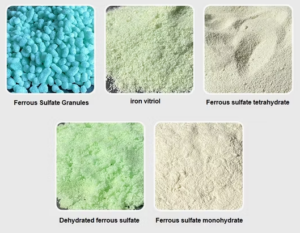
      1. By number of water molecules in ferrous sulfate formula: With strong reducibility, ferrous sulfate is easily oxidized into brown iron sulfate in the air. When we say ferrous sulfate, we mean ferrous sulfate that contains water of crystallization. Ferrous sulfate is classified into:

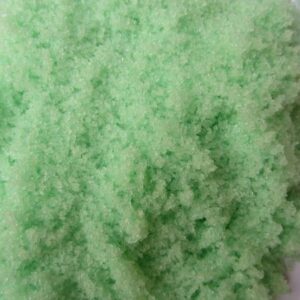
Hippocampus OU supplies mainly ferrous sulfate monohydrate (FeSO4•H2O, light gray) and ferrous sulfate heptahydrate (FeSO4•7H2O, light green), which are the two most widely used ferrous sulfates in the market.

    1. By particle size of ferrous sulfate: In practical application, size of ferrous sulfate mainly are ferrous sulfate monohydrate powder and ferrous sulfate monohydrate granular. The ferrous sulfate monohydrate particle size distribution is as follows: 6-12 mesh; 12-24 mesh; 20-40 mesh; 60-80 mesh (powder). Ferrous sulfate heptahydrate is mainly produced in powder form.
    2. By production method/technology: Ferrous sulfate is the by-products of titanium dioxide or acid pickling steel. It’s easy to produce ferrous sulfate heptahydrate after slightly dehydrated. There are two kinds of methods to make ferrous sulfate monohydrate from ferrous sulfate heptahydrate, wet and dry methods. The ferrous sulfate produced by wet method is of high content of ferrous and well-controlled lead, arsenic, and Ph value. By wet method only powder form is produced. Ferrous sulfate produced by dry method consists of both particles and powder; it has stable content, uniform particles and less dust, that is suitable for storage and transportation.

Looking for reliable supplier of Ferrous sulfate Feed Grade? Request a quote here.

Ask Your Question

WhatsApp:
+ 372 581 788 67

e-mail:
sales@hippocampus.ee
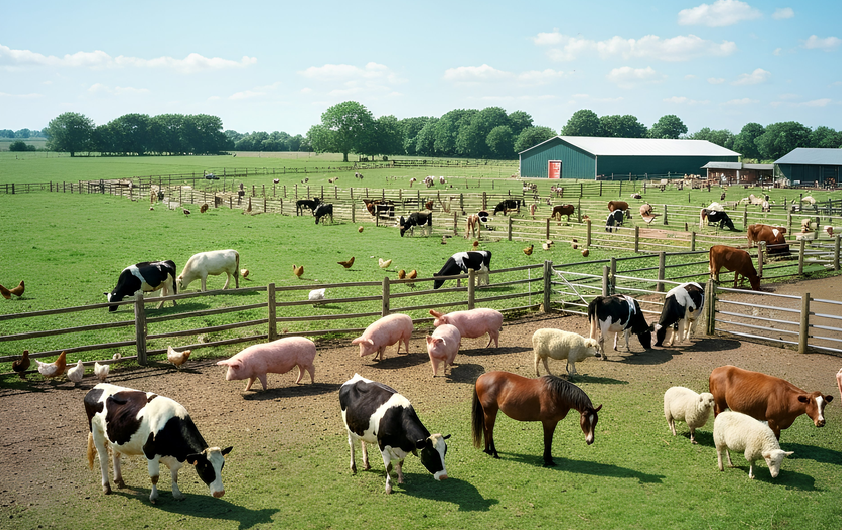
Ferrous Sulfate Monohydrate: Feeding Additive Dosage Recommendations

Ferrous Sulfate Monohydrate: Feeding Additive Dosage Recommendations

Ferrous Sulfate Monohydrate | Feed Additive Dosage GuideIntroduction

Iron is an essential trace element for the health and productivity of livestock, pets, and other animals. Ferrous sulfate monohydrate is widely recognized as an effective and reliable source of dietary iron for all animal species and categories. When used responsibly, it helps prevent iron deficiency, supports growth, and improves overall well-being.

This article provides an overview of the recommended safe dosage levels, safety considerations, and environmental impact of using ferrous sulfate monohydrate as a feed additive.

Recommended Dosage Levels for Animals

The European Food Safety Authority (EFSA) FEEDAP Panel has assessed the safe levels of iron supplementation via ferrous sulfate monohydrate in complete feed. The maximum authorized content of iron (Fe) per kilogram of feed is as follows:

  • Bovines and Poultry → up to 450 mg Fe/kg
  • Ovines → up to 500 mg Fe/kg
  • Pets → up to 600 mg Fe/kg (reduced from 1250 mg)
  • Other species/categories (except horses and fish) → up to 750 mg Fe/kg
  • Piglets (up to one week before weaning) → a maximum of 250 mg Fe/day

⚠️ Note: Due to insufficient data on horses and fish, the provisional maximum remains 750 mg Fe/kg, though further research is recommended.

Safety Considerations

1. Animal Safety

  • Supplementation with ferrous sulfate monohydrate is considered safe at the recommended levels.
  • Iron from this additive does not significantly modify iron concentrations in edible tissues or animal products.

2. User/Worker Safety

  • Ferrous sulfate monohydrate is irritant and corrosive to the skin, eyes, and respiratory tract.
  • It may contain trace levels of nickel (up to 109 mg/kg), which is a known dermal and respiratory sensitizer.
  • Long-term inhalation exposure may increase the risk of lung disease. 👉 Proper handling, protective equipment, and workplace safety measures are essential.

3. Environmental Impact

  • Considering naturally high concentrations of iron and sulfur in soil and water, supplementation of animal feed with ferrous sulfate monohydrate is not expected to pose an environmental risk.

Conclusion

Ferrous sulfate monohydrate is a safe and effective source of dietary iron when used within recommended dosage limits. Its role in supporting animal nutrition is well-documented, though care must be taken to ensure safe handling due to its irritant and sensitizing properties.

👉 By following dosage guidelines and safety recommendations, producers can maximize the benefits of ferrous sulfate monohydrate while protecting both workers and animals.


Looking for reliable supplier of Ferrous sulfate monohydrate Feed Grade? Request a quote here.

Ask Your Question

WhatsApp:
+ 372 581 788 67

e-mail:
sales@hippocampus.ee